Two numbers explain most of what a hedge fund costs, but stopping at the definition misses the part that matters: what those numbers do to your money once a bad year is followed by a good one, or once a fund's terms turn out to be a "soft" hurdle instead of a "hard" one. A fund that returns a healthy 14% gross in a single year can hand an investor closer to 10% net once both fees are applied, and that is before any of the sharper edge cases below come into play.
What the two numbers mean
"2 and 20" refers to a management fee and a performance fee, charged separately and for different reasons. The management fee, typically around 2% of assets under management, is charged every year regardless of how the fund performs. It exists to keep the lights on: salaries, research, compliance, prime brokerage costs. A fund that loses money still collects it.
The performance fee, typically around 20% of profit, is different in kind. It is only charged on gains, and usually only on gains above some threshold. Some funds calculate it on the entire profit for the year, and others calculate it only on profit that remains after the management fee has already been deducted. Both conventions exist, and the fund's offering documents, not a rule of thumb, determine which one applies to a specific fund.
"2 and 20" is also a rounder number than most real funds charge. Management fees in practice range from roughly 1% to 2.5%, and performance fees from 10% to 25% or more, depending on the fund's strategy, size, and how much bargaining power its investors have. A smaller, newer manager trying to build a track record often charges less than a large, established one with a long list of investors waiting to get in. There is also a quieter mechanical question that rarely makes it into marketing materials: is the management fee charged on the capital an investor has committed, on the capital deployed into positions, or on the fund's current net asset value? Each basis produces a different bill even at an identical headline rate, and it is worth confirming which one applies before comparing two funds' fees side by side.
A worked example: where the money goes
Take a fund managing 50 million dollars that returns 14% gross in a year, a strong result. The 2% management fee takes 1 million dollars off the top immediately, leaving 6 million dollars of the 7 million dollars in gross profit. The 20% performance fee is then charged on that remaining profit, taking 1.2 million dollars. The investor is left with 4.8 million dollars of net gain on a 50 million dollar investment, a 9.6% net return, versus the 14% the fund made.
| Scenario | Gross return | Management fee | Performance fee | Net return |
|---|---|---|---|---|
| Strong year | +14% | 1.0M | 1.2M | +9.6% |
| Flat year | 0% | 1.0M | 0 | −2.0% |
| Loss year | −6% | 1.0M | 0 | −8.0% |
Notice what happens in the flat and loss rows. The performance fee disappears, as it should, but the management fee does not. A fund that makes nothing still costs its investors 2% of their capital that year. Over several flat or mediocre years in a row, that drag compounds into a meaningfully worse outcome than the headline "20% of profit" framing suggests on its own.
The high-water mark, and what it doesn't fix
A high-water mark is the highest net asset value per share a fund has ever reached, usually tracked separately for each investor's capital. Once performance drops the fund below it, the manager cannot charge a new performance fee until the fund's value climbs back above that previous peak. If a fund falls from 100 to 80, it has to recover the full 20 back to 100 before another dollar of performance fee is charged, not just show a gain from wherever it currently sits.
Most institutional-quality funds include this provision, and it does stop a manager from being paid twice on the same recovered dollar. What it does not do is give anyone their money back. An investor who bought in near a fund's peak, watched it drop, and then watched it slowly recover to exactly where they started has still paid a performance fee on the earlier gains that preceded the drop, even though their own net result over the whole period is zero. The high-water mark protects against future double-charging. It has nothing to say about fees already collected.
Hard hurdles and soft hurdles are not the same fee
A hurdle rate sets a minimum return the fund must clear before any performance fee applies at all, and it comes in two versions that produce very different bills. Take an 80 million dollar fund with a 6% hurdle and a 20% performance fee that returns 11% gross in a year, 8.8 million dollars of profit. To keep the arithmetic clean, leave the management fee out of this one.
Under a hard hurdle, the fee applies only to the return above the hurdle. The hurdle threshold is 4.8 million dollars (6% of 80 million). The excess profit is 4 million dollars, and the fee is 20% of that, 800,000 dollars.
Under a soft hurdle, clearing the 6% threshold unlocks a fee on the entire profit, not just the amount above it. Funds usually achieve this through a catch-up clause, which hands the manager a larger share of the profit just above the hurdle until its fee equals 20% of the total. The fee becomes 20% of the full 8.8 million dollars, 1.76 million dollars, more than double the hard-hurdle version on the exact same return.
That distinction rarely gets explained in plain language in a fund's marketing materials, and the two terms sound similar enough that an investor can reasonably assume they work the same way. They don't, and the gap between them, nearly 1 million dollars in this example alone, is exactly the kind of detail worth confirming before signing anything.
Why clawbacks barely exist in hedge funds
A clawback allows investors to recover performance fees already paid if the fund later loses money. It is routine in private equity, where capital is locked up for years and a fund's true result only becomes clear once every deal has been exited. Hedge funds operate on a different clock: capital moves in and out regularly, gains and losses are marked to market constantly, and performance fees typically get paid out annually rather than at the end of a multi-year cycle.
That structure leaves little room for a workable clawback, and few hedge funds offer one. The high-water mark is often described as doing a similar job, but as covered above, it only prevents new fees during a recovery. It does not reach backward and undo fees already paid. For a hedge fund investor, the practical result is the same in both cases: profitable years get paid for as they happen, and there is generally no mechanism to reverse that payment later, whatever happens next.
Paying twice: the fund of funds problem
A fund of funds pools investor money and spreads it across several underlying hedge funds, then charges its own fee on top of whatever those underlying funds already charge. This is where 2 and 20 quietly becomes something closer to 3 and 30.
- An investor puts money into a fund of funds, which allocates it across several hedge funds, each charging roughly 2% and 20%.
- After the underlying funds take their cut, the fund of funds then applies its own layer, often around 1% and 10%, on top of what's left.
- The two layers do not simply add up in a straight line, since the second layer is charged on an already-reduced number, but the combined effect on a decent gross return routinely erases several additional percentage points that a direct investment in a single hedge fund would not have lost.
The justification for paying twice is supposed to be diversification and access, a fund of funds can get an investor into managers who are closed to new capital or too small to find on their own. Whether that access is worth the second layer of fees is a judgment call every fund of funds investor eventually has to make, and it is one reason institutional allocators have increasingly moved toward investing in hedge funds directly instead.
Why large investors rarely pay the sticker price
The 2 and 20 quoted in a fund's offering memorandum is closer to a list price than a fixed law. A pension fund, sovereign wealth fund, or endowment writing a check for tens or hundreds of millions of dollars is in a fundamentally different negotiating position than an individual investor writing a much smaller one, and funds routinely offer reduced rates, longer notice periods before redemption in exchange for lower fees, or founder share classes with a permanently discounted rate for early or large commitments.
This is also, in a roundabout way, part of why the industry-wide average fee has drifted down over time even though most individual funds still advertise something close to the traditional structure. Averages are pulled down by the large allocations that negotiate meaningfully below the sticker price, not by every fund uniformly lowering its own quoted rate. Confirming which terms a specific manager offers, rather than assuming the headline rate, is exactly the kind of question that belongs in hedge fund due diligence.
Renaissance Technologies is not evidence the fee is fair
The 2 and 20 structure is frequently defended by pointing to its best-known outlier. Renaissance Technologies' Medallion fund, run by the mathematician Jim Simons, reportedly returned an average of about 66% a year before fees between 1988 and 2018, and about 39% after them, a three-decade run with essentially no equivalent in the rest of the industry. Its fees were far above 2 and 20: by the mid-2000s, a 5% management fee and a 44% performance fee.
The trouble with using Medallion to justify hedge fund fees generally is that it is a statistical extreme, not a representative case, and it has been closed to outside money for decades: it stopped taking new outside investors in 1993 and bought out the last of them in 2005. Citing it to explain why a typical fund's 2 and 20 is reasonable is a bit like citing a lottery winner to explain why buying a ticket is a sound financial plan.
On average, the industry no longer charges 2 and 20
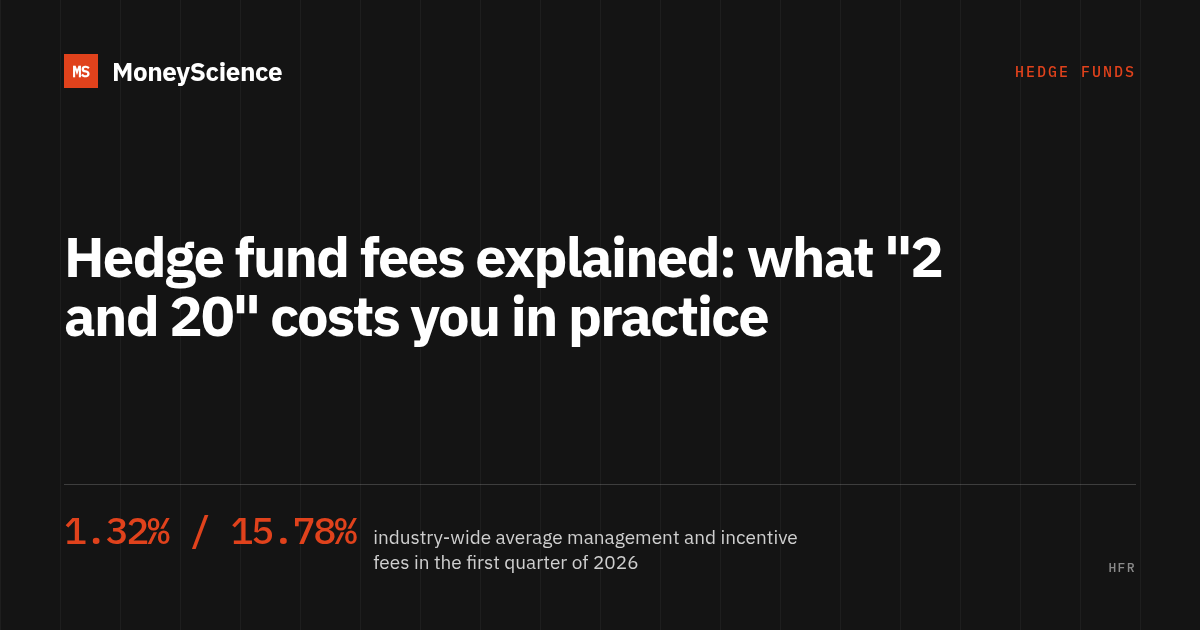
The phrase "2 and 20" has outlived the number it describes. In the first quarter of 2026, the industry-wide average management fee was an estimated 1.32% and the average incentive fee an estimated 15.78%, both below the classic figures. Funds launched in that quarter averaged 1.22% and 17.4%, newer managers still leaning slightly higher on the performance side to make up for a lower, more competitive management fee.
There's a certain irony in where the "2" came from in the first place. When Alfred Winslow Jones structured what is generally regarded as the first hedge fund in 1949, he charged a 20% performance fee and nothing else: no flat annual charge at all. The management fee was a later addition, adopted industry-wide as the business scaled through the 1980s and 1990s, and it has spent the years since drifting slightly lower even as the performance fee it was bolted onto has proven far stickier.
Frequently asked questions
Is 2 and 20 still the standard hedge fund fee today?
No, not on average. HFR put the industry-wide average at an estimated 1.32% management fee and 15.78% incentive fee in the first quarter of 2026, well below the classic 2 and 20. Individual funds, especially smaller or newer ones, still charge the full 2 and 20 or more.
Does a high-water mark mean I get my money back after a loss?
No. A high-water mark only stops the manager from charging a new performance fee until the fund's value recovers above its previous peak. It does not refund performance fees already paid on the gains that came before the loss.
What is the difference between a hurdle rate and a high-water mark?
A high-water mark is about a single fund's own history: it resets the bar to the highest point that fund has ever reached. A hurdle rate is a separate, independent minimum return, often a fixed percentage or a benchmark rate, that must be cleared before any performance fee applies at all, regardless of past highs.