A 64-year-old with 1.2 million dollars in a rollover IRA receives the subscription documents for a private hedge fund. Deep in the investor questionnaire, one question asks whether the investor is a "benefit plan investor". For an IRA the answer is yes, and the fund adds the IRA to a running total of retirement money that decides whether it can accept the subscription at all.
An IRA can own a hedge fund interest. Four things have to line up first: a custodian that will hold a private fund, an owner who passes the investor tests, a fund that has room for retirement money under the ERISA 25% rule, and a tax structure that keeps borrowed money inside the fund from turning into a tax bill for the IRA. This article is general information, not tax or investment advice.
What an IRA is allowed to own
The Internal Revenue Code names very few assets an IRA may not hold. Section 408 forbids investing IRA money in life insurance contracts, and treats the purchase of a collectible, such as art, antiques, gems, stamps, most coins and alcoholic beverages, as a distribution equal to its cost. A limited partnership interest in a hedge fund, or shares of an offshore fund corporation, falls in neither category.
The narrower limit comes from the account provider. Most custodians of ordinary IRAs limit holdings to firm-approved stocks, bonds, mutual funds and CDs. A private fund interest has no ticker, no daily price and no clearing system, so it needs a custodian set up to hold it.
Self-directed IRA custodians and what they are responsible for
A self-directed IRA is an ordinary IRA under the tax code, held by a trustee or custodian that accepts alternative assets. The custodian must be a bank or a company that has shown the IRS it can administer IRAs. The IRS publishes the list of approved nonbank trustees and custodians, most recently updated as of April 1, 2026, under Treasury Regulation section 1.408-2(e).
The custodian's job is administration. Self-directed IRA custodians do not evaluate the quality or legitimacy of an investment, do not verify the financial information supplied for it, and are responsible only for holding and administering the account's assets. The due diligence on the manager, the strategy and the fund documents stays with the IRA owner.
A subscription through a self-directed IRA usually takes four steps:
- Open the self-directed IRA and fund it by a trustee-to-trustee transfer or a rollover from an existing IRA or former employer plan.
- Complete the fund's subscription agreement in the name of the IRA, with the custodian as the legal owner of record and the individual answering the investor questions.
- Send the custodian a signed direction to invest. The custodian wires the money from the IRA to the fund.
- Each year, the fund sends its capital account or net asset value statement to the custodian, which uses it for the December 31 valuation.
Capital calls, custodian fees and any tax the IRA owes are paid from cash held in the IRA, so the account needs a cash reserve beyond the amount committed to the fund.
Accredited investor, qualified purchaser and qualified client tests for an IRA
Hedge funds are generally limited to investors who meet financial or sophistication criteria, and a fund selling under Regulation D usually accepts only accredited investors. An IRA does not have income of its own, so the test runs through the person behind it. Rule 501(a)(8) treats any entity in which all of the equity owners are accredited investors as accredited, and an IRA has one beneficial owner. The SEC staff also counts an individual and that individual's IRA as a single purchaser in a Regulation D offering (Question 255.34).
For the individual, the thresholds are 200,000 dollars of income in each of the last two years (300,000 dollars with a spouse) or 1 million dollars of net worth excluding the primary residence. The IRA balance counts toward that net worth. Our guide to accredited investor status covers how the home, the mortgage and license holders are treated.
Two higher tests apply to some funds:
- Qualified purchaser
- Funds relying on section 3(c)(7) of the Investment Company Act accept only qualified purchasers, which for a natural person means at least 5 million dollars in investments. Investments held in an IRA that the person directs and benefits from count toward that 5 million dollars under Rule 2a51-1.
- Qualified client
- A manager registered with the SEC may charge a performance fee only to qualified clients. Since June 29, 2026 the thresholds are 1.4 million dollars invested with the adviser or 2.7 million dollars of net worth.
UBTI: when fund leverage makes an IRA pay tax
An IRA is exempt from income tax on its investment income, with one exception: unrelated business taxable income, or UBTI, taxed as UBIT. Section 512 excludes dividends, interest, payments on securities loans and gains on the sale of property from UBTI. Two rules bring some of that income back.
The first is the partnership rule. A US hedge fund organized as a limited partnership is taxed as a partnership, and an IRA that is a partner must include its share of any unrelated trade or business the partnership carries on, whether or not the fund distributes anything. The second is the debt-financed property rule in section 514. When a fund buys securities with borrowed money, through margin, repo or a prime broker loan, the share of the income matching the ratio of average acquisition indebtedness to the average adjusted basis of the property becomes UBTI. For debt-financed property, this override applies to gains as well as to dividends and interest.
UBIT on a leveraged fund stake at 2026 trust rates
An IRA invests 500,000 dollars in a hedge fund partnership. Over 2026 the fund's borrowing averages one third of the adjusted basis of its securities. After the fund's interest costs, the IRA's share of the year's short-term gains and interest is 60,000 dollars.
| Line | Amount in dollars |
|---|---|
| IRA's share of the fund's net income | 60,000 |
| Debt-financed share, one third | 20,000 |
| Less the specific deduction | 1,000 |
| Unrelated business taxable income | 19,000 |
| Tax at 2026 trust rates: 3,851 plus 37% of the excess over 16,000 | 4,961 |
IRAs are taxed on UBTI at the rates for trusts, and the 2026 trust schedule is 10% up to 3,300 dollars, 24% up to 11,700 dollars, 35% up to 16,000 dollars and 37% above 16,000 dollars. The 1,000 dollar specific deduction comes from section 512(b)(12). Here the tax takes 4,961 dollars out of the IRA, about 8.3% of its 60,000 dollar share of income.
Offshore feeder funds as UBTI blockers
US tax-exempt investors generally prefer an offshore fund organized as a corporation, typically in the Cayman Islands, because the corporation acts as a "blocker". The fund corporation does the borrowing, and the IRA receives dividends or sells its shares. Dividends and gains on shares are excluded from UBTI, and the IRA itself has no acquisition indebtedness. A blocker used for specific investments typically incurs some tax of its own, which reduces what reaches the IRA.
Leverage is one source of UBTI among several. A fund that holds interests in partnerships running an active business, such as pipeline operators, passes the IRA's share of that business income through under section 512(c) even without borrowing.
Form 990-T filing for an IRA
An IRA with 1,000 dollars or more of gross income from an unrelated trade or business must file Form 990-T. The rule covers traditional, SEP, SIMPLE and Roth IRAs.
- Each IRA is a separate trust for UBTI purposes, even when one person owns several, and needs its own employer identification number to file.
- The custodian is treated as the trustee, so the custodian files the return, using the Schedule K-1 the fund issues to the IRA.
- The return is due on the 15th day of the 4th month after the tax year ends. For 2026 income, that is April 15, 2027.
- Form 990-T must be filed electronically, and estimated tax payments are required when the expected tax is 500 dollars or more.
- The tax is owed by the IRA and paid out of IRA assets.
The ERISA 25% plan asset rule and IRA money
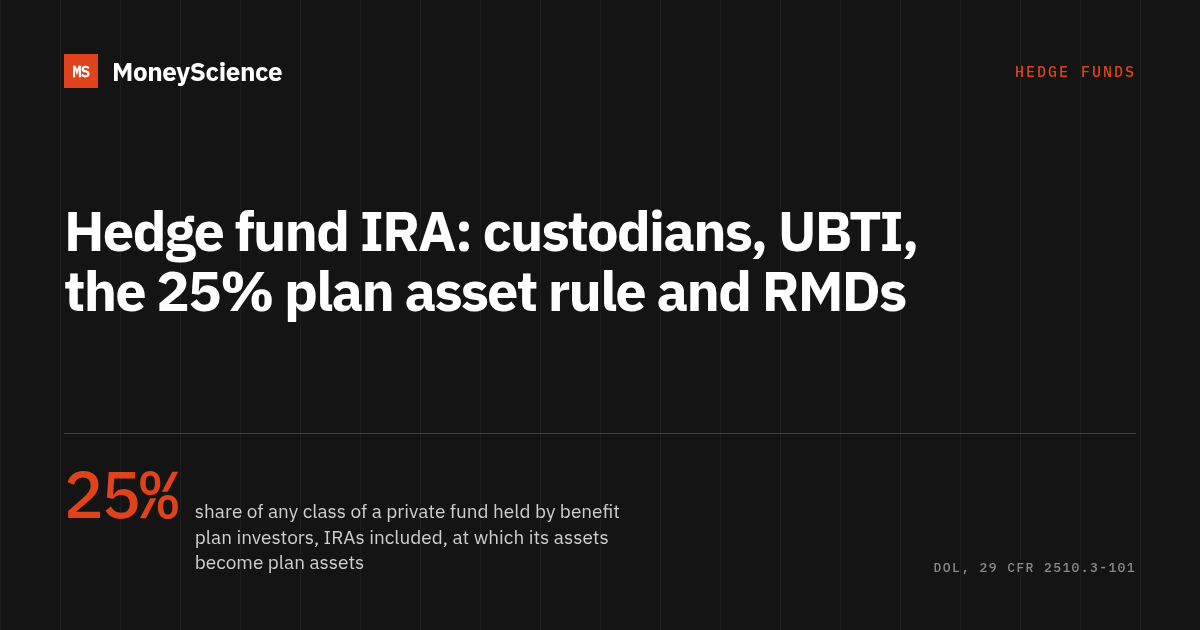
A fund can turn away an IRA whose owner passes every investor test because of the Department of Labor's plan asset regulation. When a plan buys an equity interest in a private fund, the plan's assets include an undivided interest in each of the fund's underlying assets unless the fund is an operating company or participation by benefit plan investors is not significant. Participation becomes significant when benefit plan investors hold 25% or more of the value of any class of equity interests, measured immediately after each acquisition.
IRAs count toward that 25%. The regulation's definition of a benefit plan investor includes any plan described in section 4975(e)(1) of the Code, and section 4975(e)(1) lists individual retirement accounts. The Pension Protection Act of 2006 wrote the 25% test into section 3(42) of ERISA, limited benefit plan investors to plans subject to ERISA's fiduciary rules or to section 4975, which leaves governmental and non-US plans out of the count, and kept the rule that interests held by the manager and its affiliates are disregarded.
Once the fund's assets are plan assets, anyone exercising control over them, including the manager, becomes a fiduciary of every investing plan, and the fund's own trades, fees and dealings with affiliates fall under the prohibited transaction rules. Funds that want to stay outside those rules ask every subscriber whether it is a benefit plan investor, track the running total, and can refuse new IRA and 401(k) money in a class that nears 25%.
Registered funds sit outside this test. The regulation's look-through applies only to interests that are neither publicly offered securities nor securities of an investment company registered under the Investment Company Act, so mutual funds, interval funds and ETFs can take unlimited IRA money.
Prohibited transactions and disqualified persons
Section 4975 bars a set of transactions between an IRA and a "disqualified person", whatever the terms. Disqualified persons include the IRA owner's fiduciary and family members, the family being the spouse, ancestors, lineal descendants and their spouses. The statute adds service providers to the IRA and businesses owned 50% or more by disqualified persons.
The banned transactions include a sale, exchange or lease of property, a loan, the furnishing of goods or services, the use of IRA assets for a disqualified person's benefit, and a fiduciary dealing with IRA assets in the fiduciary's own interest or receiving personal consideration in connection with them. Four cases involve hedge fund stakes directly:
- Investing in a fund you manage. A manager whose IRA pays management or performance fees to the manager's own firm can be dealing with IRA assets in the manager's own interest.
- Buying a relative's fund interest. Purchasing a partnership interest from a parent or a child is a sale between the IRA and a disqualified person.
- Guaranteeing or pledging. A personal guarantee of a loan to the IRA is an extension of credit between the IRA and a disqualified person, and using the IRA as security for a personal loan is treated as a distribution of the pledged portion.
- Side benefits. A fee break on the owner's taxable account in the same fund, granted because the IRA invested, can count as use of IRA assets for a disqualified person's benefit.
If the IRA owner or a beneficiary engages in a prohibited transaction, the account ceases to be an IRA as of the first day of that year, and section 408(e)(2) treats all its assets as distributed at their fair market value on that date. The value above any basis in the account becomes taxable income, and an owner under 59½ may also owe the 10% additional tax. Other disqualified persons who take part pay an excise tax of 15% of the amount involved for each year, rising to 100% if the transaction is not corrected.
Year-end valuation on Form 5498
Every year, the custodian reports the fair market value of each IRA as of December 31 on Form 5498. Hedge fund stakes also go on a separate line of Form 5498. Box 15a shows the value of assets without a readily available market value, and box 15b shows their type by code:
- code A for stock in a corporation not readily tradable, which covers shares of an offshore feeder fund
- code C for an interest in a limited liability company
- code E for an interest in a partnership, the usual onshore hedge fund
- code H when more than two types are held
For 2026, the custodian gives the owner a statement of the account's value by February 1, 2027 and files Form 5498 with the IRS by May 31, 2027. The custodian has no market price to look up, so it relies on the value the fund or the owner supplies, usually the fund's year-end capital account statement.
That December 31 figure is the balance used for the next year's required minimum distribution, so a stale or overstated value changes the amount the owner must withdraw.
Required minimum distributions with an illiquid fund
Traditional IRA owners must begin required minimum distributions by April 1 of the year after they reach 73. Each year's amount is the prior December 31 balance divided by the factor for the owner's age in the Uniform Lifetime Table in Publication 590-B, which is 24.6 at age 75.
Take a 75-year-old whose IRA was worth 900,000 dollars at the end of 2025, of which 600,000 dollars sits in a hedge fund. The 2026 distribution is 900,000 divided by 24.6, or 36,585 dollars. The fund's share of the balance counts toward that figure whether or not the fund can pay out in 2026.
Hedge funds usually allow redemptions four times a year or fewer, often after a lock-up of a year or more, and can suspend redemptions in market stress. The owner has three ways to cover the distribution:
- Keep enough cash or listed securities in the IRA, or in another IRA, since the minimums for all of an owner's IRAs can be added up and taken from any one or more of them.
- Submit a redemption request early enough to meet the fund's notice period before December 31.
- Distribute part of the fund interest itself, if the fund allows transfers. The custodian reports a distribution of assets without a readily available market value with code K on Form 1099-R, and the owner is taxed on the fair market value.
Missing the deadline costs an excise tax of 25% of the shortfall, reduced to 10% when the owner takes the missed amount and files a return reflecting the tax within the correction window. Roth IRA owners have no required distributions during their lifetime.
Traditional or Roth IRA for a hedge fund stake
| Point | Traditional IRA | Roth IRA |
|---|---|---|
| Tax on gains while held | None, except UBIT | None, except UBIT |
| UBIT and Form 990-T | Apply | Apply |
| Tax on withdrawals | Ordinary income, with no capital gains rate | None on qualified distributions |
| Required distributions during the owner's life | From age 73 | None |
| 2026 contribution limit | 7,500 dollars, 8,600 dollars from age 50 | 7,500 dollars, 8,600 dollars from age 50 |
A Roth distribution is qualified when it comes more than five years after the first Roth contribution and the owner is at least 59½, disabled or deceased, or it is used for a first home up to 10,000 dollars. The 2026 contribution limits come from Publication 590-A.
The traditional IRA converts every dollar of hedge fund profit, including long-term gains, into ordinary income when it comes out. That matters less for strategies whose returns are mostly short-term gains and interest, which would be taxed at ordinary rates in a taxable account anyway. Our comparison of hedge funds and mutual funds covers how a K-1 and a 1099-DIV are taxed in a taxable account.
Registered alternative funds in an ordinary IRA
Several hedge fund style products are registered under the Investment Company Act and sit in a standard brokerage IRA with none of the steps above:
- Liquid alternative mutual funds and ETFs run long/short, market neutral, managed futures or multi-strategy portfolios with daily liquidity and no investor test.
- Interval funds buy back between 5% and 25% of their shares at set intervals under Rule 23c-3, and some hold stakes in private hedge funds.
- Listed closed-end funds trade on an exchange at a market price that can sit above or below their net asset value.
These funds are registered investment companies, so the plan asset look-through does not apply and no 25% cap limits IRA money. They usually pay their income out as dividends, which section 512(b)(1) excludes from UBTI. An interval fund that owns hedge funds counts those funds' own fees in its expense ratio. Our guide on investing in hedge funds with little money compares their fees, minimums and exit terms.
Questions for the fund manager and the custodian before an IRA subscribes
- Is the IRA investing in an onshore partnership or an offshore corporate feeder, and what UBTI did the fund report to tax-exempt investors in the last three years?
- What share of the class do benefit plan investors hold today, and will the fund cap or redeem IRA investors if it nears 25%?
- What are the lock-up, notice period, redemption frequency, gate and suspension terms, and do they allow an in-kind transfer for a required distribution?
- When does the fund deliver its December 31 value and its Schedule K-1, and does the custodian accept that timing?
- What does the custodian charge each year for holding the asset, processing capital calls and preparing or filing Form 990-T?
- Does anyone connected to the IRA owner, including relatives and their businesses, have a role or an economic interest in the fund or its manager?
Common questions about hedge funds in IRAs
Can you invest in a hedge fund with an IRA?
Yes. The tax code bars an IRA from buying collectibles and life insurance contracts, and a limited partnership interest in a hedge fund falls in neither category. In practice the IRA needs a self-directed custodian willing to hold the interest, the IRA owner usually has to be an accredited investor, and the fund has to have room for benefit plan investors, since funds that stay outside ERISA keep them below 25% of each class of interests.
Can I use my Fidelity or Schwab IRA to buy into a private hedge fund?
Mainstream brokerage IRAs generally limit holdings to the securities and funds on their own platforms. A private fund interest is held through a self-directed IRA at a bank or at a nonbank trustee on the IRS list of approved nonbank trustees and custodians, funded by a transfer or a rollover from the existing account.
Does a Roth IRA pay UBIT on hedge fund income?
Yes, if the fund generates unrelated business taxable income. Roth IRAs fall under the same Form 990-T filing rule as traditional, SEP and SIMPLE IRAs, so a Roth IRA with 1,000 dollars or more of gross unrelated business income files the return and pays the tax from the account, even though qualified withdrawals later come out tax-free.
Can I invest my IRA in a hedge fund I manage?
The Code forbids a fiduciary from dealing with IRA assets in the fiduciary's own interest or receiving personal consideration in connection with a transaction involving them. A manager who puts their own IRA into their own fund and collects management or performance fees on that money risks a prohibited transaction, and the IRA then ceases to be an IRA as of January 1 of that year, with all its assets treated as distributed at fair market value.
How is a hedge fund valued inside an IRA each year?
The custodian reports the fair market value of the whole IRA as of December 31 on Form 5498, and reports hard-to-value holdings separately in box 15a with a code in box 15b, code E for a partnership interest. The figure usually comes from the net asset value statement the fund sends, and for 2026 the Form 5498 is due to the IRS by May 31, 2027.