A software company owned by a private equity firm needs 400 million dollars to buy a competitor. Twenty years ago that meant assembling a bank syndicate, or selling high-yield bonds to the public market and accepting whatever price investors set that week. Today it often means a phone call to two or three credit funds, a set of terms agreed in private, and money wired within weeks. No prospectus, no rating agency, no daily price.
That shift is what people mean by private credit, and it now finances a large share of corporate America.
What private credit is
Private credit is lending to companies by investment funds instead of banks or public bond markets, on terms negotiated privately between the borrower and the lender. The manager raises capital from pension funds, insurers, endowments and, increasingly, individuals. It lends that capital directly. Investors receive the interest, minus fees.
Three features separate it from the alternatives an investor might already own:
- No public market. The loan is not listed anywhere. There is no screen price, and usually no public credit rating.
- Floating rates. Most direct loans pay a spread over a reference rate, so the coupon rises and falls with short-term interest rates rather than with a fixed schedule.
- Bilateral terms. Covenants, maturity, amortisation and pricing are negotiated one to one, which is why borrowers pay up for speed and flexibility.
The scale depends entirely on where you draw the line. The Financial Stability Board, using a narrow definition of nonbank direct lending to medium-sized companies, put the total at 1.5 to 2 trillion dollars at the end of 2024. Moody's expects assets under management to exceed 2 trillion dollars in 2026 and approach 4 trillion by 2030. Broader definitions that sweep in asset-based lending and fund finance run higher still. Any single number you see quoted is a definitional choice, not a measurement.
Why it exists at all
The usual explanation is that banks retreated after the 2008 crisis, and that is partly true: capital rules made holding leveraged loans more expensive, so balance sheet lending to mid-sized companies became less attractive relative to other uses of bank capital.
The more interesting half of the story is that banks did not leave. They moved up the chain and began lending to the lenders. US bank loans to nondepository financial institutions, the category that captures credit funds, private equity vehicles and similar intermediaries, were the fastest-growing loan segment reported on Call Reports between 2010 and 2024, compounding at 21.9% a year, according to the FDIC. The next fastest, multifamily commercial real estate, grew at 7.7%.
Borrowers had their own reasons to switch. A private credit fund can commit to a whole financing, keep it on its books, and close in weeks without a syndication process or a public rating. For a sponsor racing to sign an acquisition, certainty and speed are worth more than the last fifty basis points of spread.
The shapes it takes
"Private credit" covers strategies with very different risk profiles. The label alone tells you almost nothing about what you own.
- Direct lending
- The core of the market. Senior secured loans to mid-sized companies, often structured as unitranche, a single facility that blends what used to be senior and subordinated debt into one instrument at one blended rate. Usually floating rate, usually backed by a private equity sponsor.
- Asset-based finance
- Lending against pools of contractual cash flows: equipment leases, receivables, royalties, consumer loans, aircraft. The repayment source is the collateral rather than a company's earnings, which makes it a different bet from corporate lending even inside the same fund.
- Mezzanine and subordinated debt
- Debt that sits below senior loans in the capital structure, paid after them in a bankruptcy, and priced higher to compensate. Often carries equity warrants.
- Special situations and distressed
- Buying or lending into companies already in trouble, with returns driven by restructuring outcomes rather than by coupons. The closest thing in private credit to a hedge fund strategy.
- Venture debt
- Loans to venture-backed startups that have equity investors but little in the way of profits or hard assets. Small, high loss-given-default, priced accordingly.
How it differs from the things it replaced
Private credit competes with two older ways of financing the same company, and it is worth being precise about what changes.
A broadly syndicated loan is arranged by a bank and sold to dozens of institutional buyers, mostly CLOs and loan funds. It trades in a secondary market, carries public ratings, and is priced daily, so a deteriorating credit shows up as a falling price within days. A high yield bond is a public security with a fixed coupon, a prospectus and a ratings history.
A private loan replaces all of that with one or two lenders, no market price, and terms only the parties see. Pricing is higher, partly as compensation for illiquidity and partly because the borrower is paying for speed and certainty. The lender keeps the loan, so it has a direct incentive to police it, and it can renegotiate quickly when the borrower stumbles, without waiting for a bondholder committee.
The same trait explains both the appeal and the discomfort. Bilateral control makes a workout faster, and it also means the only person marking the loan, deciding whether an amendment counts as a problem, and reporting the outcome to investors, is the lender.
Private credit is also frequently confused with private equity, which owns companies and profits from their appreciation. Private credit lends to them. Returns come from contractual interest with a capped upside, and the risk is not that the business fails to grow, but that it cannot pay.
How a single loan pays
Strip away the fund wrapper and the economics of direct lending are simple enough to work through on one loan.
Say a fund writes a 100 million dollar unitranche facility to a sponsor-owned company. In the second quarter of 2026, according to Valuation Research Corporation, US unitranche coupons ran roughly 4.75% to 5.50% over SOFR, with original issue discounts between 98.75 and 99.25, and leverage on high-quality deals in the 5 to 6 times EBITDA range.
Put those together with a 4% reference rate:
- Coupon: SOFR plus 5.25%, so about 9.25% a year in cash interest while rates stay where they are.
- Original issue discount: the fund lends 99 cents and is repaid 100, adding a fraction of a point a year to the yield over the life of the loan.
- Fees and call protection: arrangement fees at closing, and penalties if the borrower repays early, which matter because most of these loans are refinanced long before their stated maturity.
Notice which way the coupon moves. Because the rate floats, the lender's income rises when central banks tighten, at exactly the moment the borrower's interest bill rises too. Floating rates transfer interest rate risk to the borrower and convert it into credit risk for the lender. That trade looked brilliant in 2022 and 2023. It is the reason the default numbers below are now going up.
What the returns actually look like
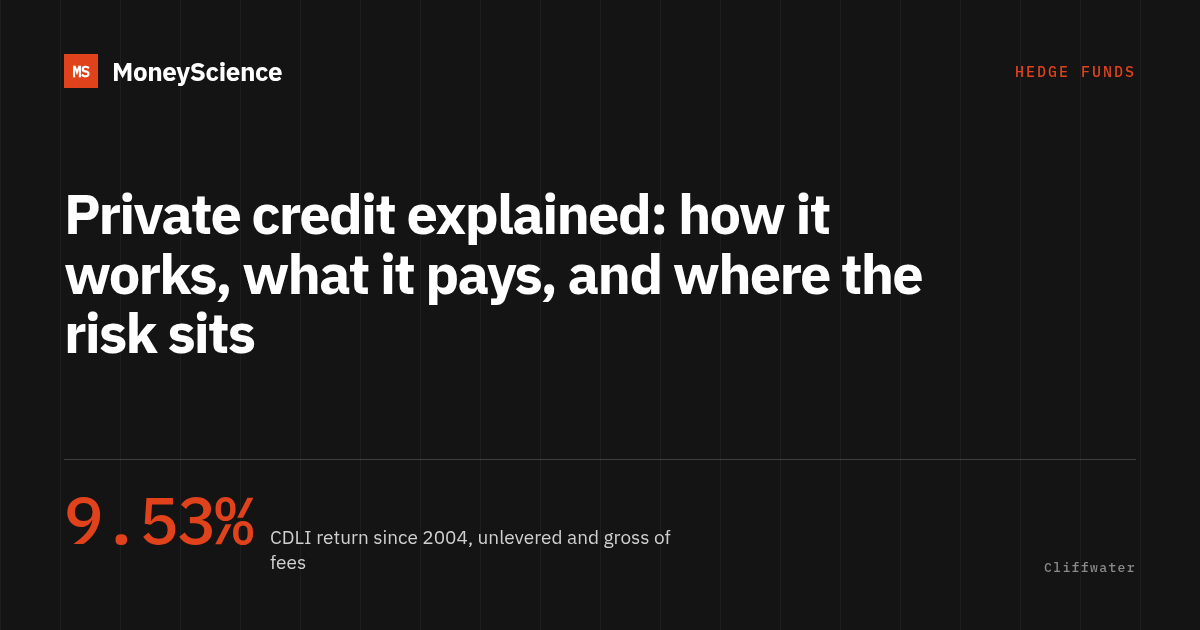
The most commonly cited benchmark is the Cliffwater Direct Lending Index, which measures US middle market loans held by business development companies. Its fact page, as of December 31, 2025, shows 549 billion dollars of assets, roughly 21,000 loan holdings, 87% of them senior, and an annualized return of 9.53% since inception in September 2004.
That number is real, and it is also the most misread figure in the asset class. Three footnotes change what it means:
- It is unlevered and gross of fees. Fund-level fees and any leverage the manager uses are not in it.
- The index launched on September 30, 2015. Everything before that date is back-tested, which Cliffwater discloses plainly and which carries the usual survivorship and look-ahead caveats.
- It reflects the assets of BDCs, so it describes the part of the market that reports through a regulated wrapper, not every private loan ever written.
Take the headline return, subtract a management fee, subtract an incentive fee, and the gap between the index and an investor's statement is not small. It is the whole argument for reading a fund's own net performance instead of the benchmark in the marketing deck.
Nobody agrees what counts as a default
This is where the asset class gets genuinely confusing, and where most explainers stop. Three respected sources published wildly different default rates for the same market in 2026.
| Source | Rate | What it measures |
|---|---|---|
| Proskauer, Q2 2026 | 2.51% | 716 senior secured and unitranche loans, 195.6 billion dollars of original principal |
| Fitch, August 2026 | 6.3% | Trailing twelve months across roughly 1,300 borrowers, a record for the series |
| Moody's, full-year 2025 | 1.6% to 4.7% | A range, because the answer depends on the definition applied |
The gap is not sloppiness. It is the definition of default doing the work. Proskauer's index tracks a specific sample of senior loans. Fitch's measure, which reached its record in August 2026, counts distressed restructurings alongside missed payments. And Moody's found that distressed restructurings accounted for roughly 65% of all private credit defaults in 2025.
Read that last number again. In a market where most "defaults" are negotiated restructurings rather than missed payments, the lender and the borrower are often deciding together whether a problem is a default at all.
The related signal to watch is payment-in-kind interest, where a borrower pays its coupon in more debt instead of cash. PIK is legitimate in some structures and a warning sign in others, because it converts a cash problem into an accounting entry. Moody's noted PIK income rising as a share of investment income as of March 2026, and that BDC credit risk had widened relative to comparable rated public companies.
That composition detail is worth more than the headline rate. Of the 14 private credit defaults Fitch counted in May 2026, Valuation Research notes that around half were maturity extensions, five added a PIK component, and only two involved an actual missed interest payment. Most "defaults" in this market are documents being rewritten, not cheques bouncing.
The leverage you do not see on the loan
A senior loan at 5 to 6 times a borrower's earnings is one layer of leverage. The fund that holds it usually adds another.
Business development companies were limited to roughly one dollar of debt per dollar of equity until the Small Business Credit Availability Act of 2018 cut the required asset coverage from 200% to 150%, which lets a BDC run about two dollars of debt for every dollar of equity once its shareholders or independent directors approve. The requirement itself sits in the Investment Company Act, and nearly every large BDC has taken the higher limit.
Beyond that sit subscription lines, NAV facilities and fund portfolio financing, which is the securitised lending the FSB singled out as a channel that lets funds add leverage against their loan books. Stack it up and a modest-looking senior loan can support a chain of borrowings: the company, the fund, and sometimes the investor. The IMF's phrase for this is multiple layers of leverage, and it is why the asset class behaves less defensively in a downturn than a senior secured label suggests.
The valuation problem
A listed bond tells you what it is worth every second of the trading day, whether or not you like the answer. A private loan is marked by a model, quarterly, using inputs the manager selects and a valuation process the manager oversees.
That produces the smooth return series investors find attractive, and it is also the vulnerability the IMF flagged in its April 2024 Global Financial Stability Report: fragile borrowers, a growing share of semi-liquid vehicles, layered leverage, and stale or subjective valuations. Stale marks create a first-mover advantage, because the investor who redeems first gets out at a price that has not yet caught up with reality.
Low measured volatility in an asset that is only priced four times a year by its own manager is not the same thing as low risk. It is partly an artefact of the measurement, in the same way that the econophysics research on fat tails shows why smooth-looking series can hide the moves that matter.
Two fund shapes, two very different experiences
Institutions and individuals typically meet private credit through structures that behave nothing alike.
A drawdown fund has a fixed life, commonly eight to ten years. You commit capital, the manager calls it in pieces as loans are made, income comes back as borrowers pay, and the fund winds down. You cannot redeem, because there is nothing to redeem from, and your money comes back as the portfolio repays. Fees are charged on committed or invested capital, and early years look unimpressive while fees run ahead of income.
An evergreen fund, the shape behind most retail products, never ends. It sells shares monthly at net asset value, reinvests repayments, pays a monthly distribution, and offers limited quarterly repurchases. It solves the commitment problem that kept individuals out, and it creates a new one: a perpetual vehicle holding illiquid loans has to satisfy redemptions from cash, new subscriptions, or borrowings. As long as money is flowing in, this is invisible. Moody's expects evergreen adoption to keep reshaping distribution, and notes that volatility could grow as retail investors take a bigger role.
How individuals actually get in
Until recently the answer was that they did not. That has changed, through three routes:
- Non-traded BDCs. Perpetual vehicles that take monthly subscriptions at net asset value and offer limited quarterly repurchases. This is the channel that opened private credit to ordinary investors.
- Interval and tender offer funds. Registered funds that buy private loans and repurchase a set slice of shares each quarter. Under SEC Rule 23c-3, an interval fund commits to repurchasing between 5% and 25% of shares per period, may accept up to 2% more if a repurchase is oversubscribed, and must otherwise cut every request back pro rata.
- Listed BDCs. Bought and sold like any stock, with daily liquidity, but priced at whatever discount or premium to NAV the market decides, which reintroduces the volatility investors came here to avoid.
The terms are public and worth reading before the pitch. Blackstone's BCRED, the largest non-traded BDC, discloses a 1.25% annual management fee on NAV, a 12.5% incentive fee on net investment income above a 5% hurdle with a catch-up, monthly subscriptions at NAV, and quarterly repurchases capped at 5% of shares outstanding. Shares held less than a year are repurchased at 98% of NAV, and the board can amend or suspend repurchases at its discretion.
Work through what that cap means in a bad quarter. If holders of 20% of the fund ask for their money back at once, the 5% cap is oversubscribed fourfold, so each investor gets about a quarter of what they asked for and rejoins the queue next quarter. Nothing has gone wrong and no rule has been broken. The gate is the product working as designed, which is precisely the feature that lets the manager avoid dumping loans at distressed prices.
The question to settle in advance is whether you would accept that trade in the quarter when you most want your money back.
What it costs
Fees deserve the same arithmetic we applied to hedge fund fees. A 1.25% management fee plus 12.5% of income above a hurdle sits below the classic 2 and 20, but it is charged on an asset whose gross yield comes mainly from a floating coupon rather than from capital gains.
So the proportions matter. Take a portfolio of senior loans yielding roughly 10% gross. The 1.25% management fee comes off first, leaving about 8.75% of net investment income, and the incentive fee then claims 12.5% of the part above the hurdle, a little over one point more. Fees of roughly 2 to 2.5 percentage points, before a single borrower misses a payment.
Where the systemic worry sits
Regulators have spent two years mapping this market, and their concern is less about individual loans than about what connects to what.
The FSB's May 2026 report found that direct bank lending to private credit funds looks modest on the surface, about 220 billion dollars of drawn and undrawn credit lines in data supplied by member authorities, while commercial data suggests the true figure could be more than twice that. Its conclusion on the data gap is the point: the uncertainty is large. The report also notes that private credit borrowers, where rated at all, are often rated around single B, and that the asset class remains untested through a prolonged downturn.
None of that makes private credit a bubble. It does mean the reassuring feature of the asset class, that losses have been modest so far, rests on a sample that has never included a long recession.
How to weigh an allocation
This is general information rather than advice for any particular situation, but five questions separate a serious look from a brochure:
- What does the fund report net of all fees and leverage, and over what period, compared with a liquid credit benchmark?
- Who values the loans, how often, and what independent check sits on that process?
- What share of investment income is PIK rather than cash, and which direction is it moving?
- What exactly happens to a redemption request in a quarter when the gate binds?
- How much of the portfolio sits in a single sector, a single sponsor, or loans to companies that also borrow elsewhere?
Those are the same habits that hedge fund due diligence applies to any private, manager-marked strategy. The asset class is new to most individual investors. The questions are not.
Frequently asked questions
What is private credit in simple terms?
Private credit is lending to companies by funds rather than by banks or public bond markets. A manager raises money from investors, lends it directly to a borrower on privately negotiated terms, and passes the interest back to investors after fees. The loan is not traded on an exchange and usually has no public credit rating.
What returns has private credit delivered?
The Cliffwater Direct Lending Index, which tracks US middle market loans held by business development companies, shows a 9.53% annualized return since September 2004, measured as of December 31, 2025. That figure is unlevered and gross of fees, and the period before the index launched in 2015 is back-tested, so an investor's net result in a real fund is lower.
Can retail investors buy private credit?
Yes, mostly through non-traded business development companies and interval or tender offer funds, which accept ordinary investors with modest minimums and offer limited quarterly liquidity. Listed BDCs trade like stocks. Traditional closed-end private credit funds remain restricted to accredited and institutional investors.
Why do private credit default rates differ so much between sources?
Because each source counts different things. Proskauer's index tracks senior secured and unitranche loans in its own sample and reported 2.51% for the second quarter of 2026, while Fitch's trailing twelve-month rate across roughly 1,300 borrowers hit a record 6.3% at the end of August 2026. Fitch captures distressed restructurings and amendments that narrower measures treat as workouts rather than defaults.